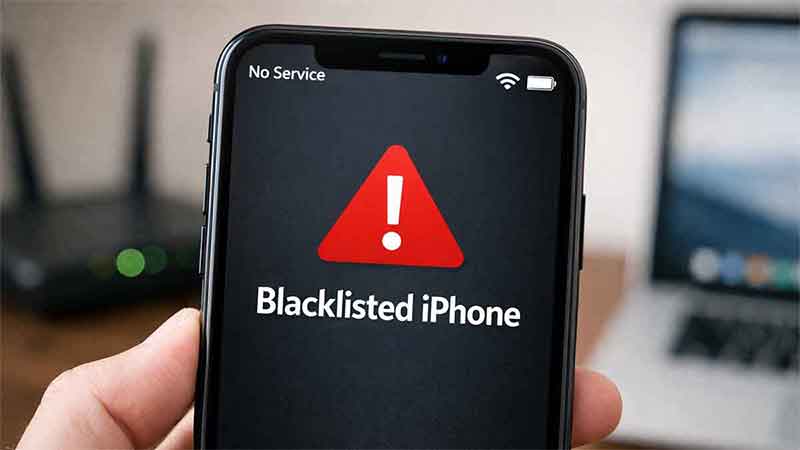

Buying a used iPhone has never been more popular—or more risky. With flagship models pushing well beyond the four-figure mark, consumers are increasingly turning to refurbished devices, peer-to-peer marketplaces, and international resellers to save money. But alongside this booming secondary market comes a persistent and often misunderstood problem: blacklisted iPhones.
A blacklisted iPhone may look fully functional, power on normally, and even pass basic setup screens, yet remain permanently blocked from cellular networks. For buyers, that can mean discovering—too late—that a newly purchased device cannot make calls, send texts, or use mobile data on any carrier. For resellers, it can result in chargebacks, reputational damage, and inventory losses.
Understanding how blacklisting works, how to detect it before purchase, and whether recovery is even possible has become essential knowledge for anyone buying or selling iPhones in today’s market.
Why Blacklisted iPhones Are a Growing Problem in the Used Market
The global trade in second-hand smartphones is expanding rapidly, driven by rising device prices, sustainability initiatives, and strong demand for refurbished electronics. iPhones, in particular, retain high resale value and long software support, making them prime targets for both legitimate reselling—and fraud.
One major contributor to blacklisting is insurance and theft reporting. When an iPhone is reported lost or stolen, carriers flag its IMEI in shared databases that block the device from connecting to most cellular networks worldwide. Even if the phone is later recovered or resold, that blacklist status often remains unless the original account holder formally requests removal.
Another growing source is unpaid financing and contract defaults. Many iPhones are sold through installment plans. If payments stop, carriers may blacklist the device even if it has already been resold to a third party who had no involvement in the original contract. From the buyer’s perspective, the phone appears legitimate—but it is still network-blocked.
Online marketplaces also play a role. Cross-border reselling, bulk liquidation, and minimal device vetting increase the odds that blacklisted phones slip into circulation. Listings may describe devices as “unlocked” or “working,” which can be technically true in terms of software and Wi-Fi use, while omitting the more critical fact that the IMEI is barred from cellular service.
The result is a market where visual inspection and basic functionality tests are no longer enough. Without an IMEI check, buyers are effectively gambling on network eligibility—often discovering problems only after the return window has closed or the seller has disappeared.
What Does “Blacklisted” Mean on an iPhone? (IMEI Explained)
When an iPhone is described as blacklisted, it means the device’s IMEI number—its unique hardware identifier—has been flagged in carrier databases as ineligible for cellular service.
The IMEI (International Mobile Equipment Identity) is a 15-digit code assigned to every mobile device. Cellular networks use it to identify and authenticate phones attempting to connect. When an IMEI is added to a blacklist, carriers refuse network access regardless of which SIM card is inserted.
How iPhone Blacklisting Happens
Blacklisting is typically triggered by carriers, not Apple, and most commonly occurs for three reasons:
- Reported lost or stolen: If the owner files a theft or loss claim, especially through insurance, the carrier blocks the IMEI to prevent resale and misuse.
- Unpaid bills or contract default: Devices purchased on installment plans can be blacklisted if the account goes into collections.
- Fraud investigations: Accounts associated with identity theft or chargeback abuse may result in device blacklisting.
Once flagged, the IMEI is often shared through international databases, meaning the device may be blocked across multiple countries and carriers, not just the original network.
What Still Works on a Blacklisted iPhone
A key source of confusion is that blacklisted iPhones are not “bricked.” Most device functions still operate normally:
- Wi-Fi connectivity
- App downloads and iOS updates
- Camera, media, and offline apps
What does not work is any service requiring carrier authentication:
- Voice calls
- SMS and MMS
- Mobile data
This partial functionality is why many buyers don’t realize a phone is blacklisted until after purchase, especially if they test the device only on Wi-Fi or during brief in-store demos.
Blacklisted vs Carrier Locked vs iCloud Locked — Key Differences
Not all “locked” iPhones are the same, and confusing these terms is one of the most common—and costly—mistakes in the used phone market. Each restriction operates at a different level of the device and has very different implications for usability and recovery.
Carrier Locked: Network Restriction by Contract
A carrier-locked iPhone is restricted to a specific network until the original contract or financing terms are met. This is a software-level restriction controlled by the carrier.
- The phone can connect to cellular service, but only on the original carrier
- Once eligibility requirements are met, carriers can usually officially unlock the device
- After unlocking, the phone can be used on other compatible networks
Carrier locks are common and generally reversible.
Blacklisted: Network Ban at the IMEI Level
A blacklisted iPhone is blocked at the hardware identifier level, meaning carriers refuse to authenticate the device at all.
- The phone cannot connect to cellular networks, even if it is carrier-unlocked
- Unlocking does not remove blacklist status
- Removal usually requires action from the original carrier and account holder
This is why listings that say “factory unlocked” can still be misleading if the IMEI is blacklisted.
iCloud Locked (Activation Lock): Apple Account Protection
An iCloud-locked iPhone is protected by Apple’s Activation Lock, which ties the device to the previous owner’s Apple ID.
- The phone cannot be set up or used normally without the Apple ID password
- Cellular status is irrelevant if Activation Lock is active
- Only the original owner or Apple (with proof of purchase) can remove it
This is a security feature designed to deter theft and is entirely separate from carrier blacklisting.
Why These Distinctions Matter for Buyers
From a practical standpoint:
- A carrier-locked iPhone may still be a good purchase if it can be officially unlocked later.
- A blacklisted iPhone is usually a poor investment unless it is intended for parts or Wi-Fi-only use.
- An iCloud-locked iPhone is effectively unusable and should be avoided entirely.
Understanding which restriction applies is critical, because the solutions—and the risks—are completely different in each case.
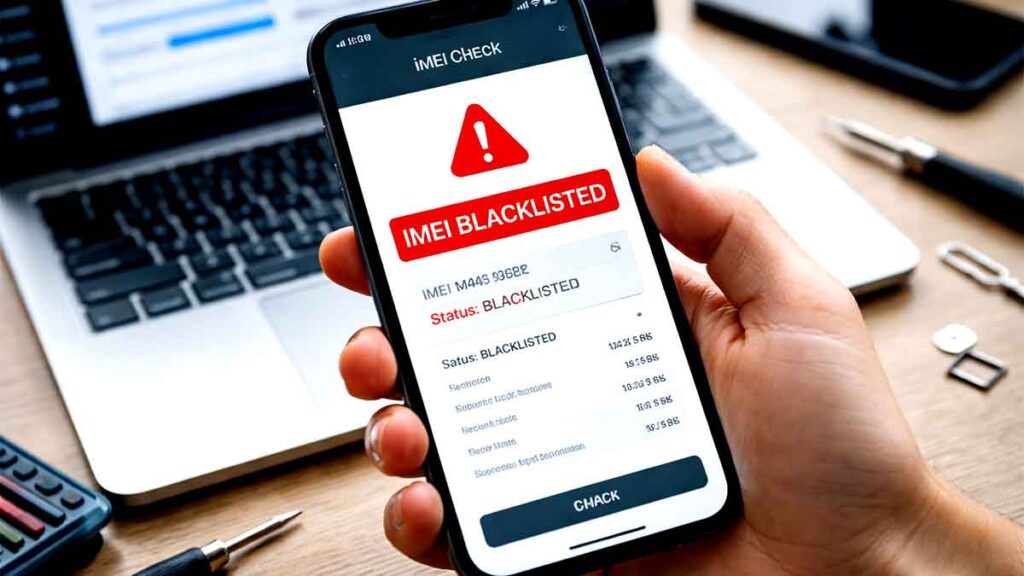
How to Check If an iPhone Is Blacklisted (Step-by-Step Guide)
Checking blacklist status is not difficult, but it does require more than simply powering on the device. Because blacklisting happens at the network level, proper verification always starts with the iPhone’s IMEI.
Find the iPhone’s IMEI Number
Before running any checks, confirm the correct IMEI:
- Settings: Go to Settings → General → About
- SIM tray: Printed on the tray for most models
- Apple ID account: Under Devices when logged into iCloud
- Original box: Printed near the barcode label
For used devices, it is important to confirm that the IMEI shown in settings matches the number on the SIM tray and box. Mismatches can indicate tampering or housing replacement, which adds additional risk.
Check with Carrier IMEI Databases
Most major carriers provide public or customer-service-based IMEI checks that confirm whether a device is:
- Eligible for activation
- Reported lost or stolen
- Blocked for unpaid balances
This method is useful when you know the original carrier, but it has limitations. A phone may appear clear on one carrier’s system while still being blocked internationally, especially if the blacklist report was filed in another country.
Carrier tools are best viewed as preliminary checks, not definitive clearance.
Use Professional IMEI Check Services
For resale buyers and refurbishers, third-party IMEI reports provide the most complete picture. These services typically query multiple databases and may include:
- Blacklist status (clean, lost, stolen, fraud)
- Original carrier and country of sale
- Financing and contract status
- Activation Lock indicators
Paid reports are more reliable than free tools, which often check only limited or outdated databases. When reviewing results, pay attention to status codes and remarks, not just “pass/fail” labels, as some devices are flagged under financial blocks rather than theft reports.
From a professional standpoint, this is the closest equivalent to a background check for mobile devices.
Test with Active SIM Cards (Supplementary Check Only)
Inserting a working SIM card and confirming network access can help detect obvious blocks, but it should never be the only test used.
Some blacklisted phones may:
- Temporarily connect during roaming
- Retain service during short grace periods
- Work on limited regional networks
Because blacklist propagation is not always instant or universal, a phone that works today may lose service later. SIM testing is useful as a functional check, but IMEI verification remains essential.
Can a Blacklisted iPhone Still Be Unlocked?
This is one of the most searched—and most misunderstood—questions in the used iPhone market. The short answer is: unlocking and blacklist removal are two entirely different processes.
Unlocking Does Not Remove Blacklist Status
Carrier unlocking removes restrictions that limit a phone to a specific network. Blacklisting, however, blocks the device at the IMEI level across carrier systems.
That means an iPhone can be:
- Factory unlocked
- Fully updated and reset
- Still completely unable to access cellular service
Unlocking affects which networks the phone is allowed to try, while blacklisting determines whether any network will accept it at all.
When Blacklist Removal Is Sometimes Possible
In limited situations, blacklist status can be reversed, but only through official channels:
- The device was incorrectly reported lost or stolen
- An insurance claim was canceled after recovery
- Outstanding balances were paid and carrier records updated
In all of these cases, removal must be requested by the original account holder through the original carrier. Third-party buyers generally cannot initiate this process themselves.
Even when conditions are favorable, carriers may take days or weeks to update shared databases.
When Blacklist Removal Is Effectively Permanent
If a device was reported stolen and an insurance payout was issued, or if fraud was involved, blacklist status is rarely—if ever—removed.
In these cases, no software tool, unlocking service, or repair shop can legally restore cellular functionality. Claims of permanent fixes typically involve:
- IMEI manipulation
- Temporary network routing
- Illegal database interference
All of which carry serious legal and service risks and often stop working once databases resynchronize.
What This Means for Buyers
From a buyer’s perspective, a blacklisted iPhone should be treated as:
- Non-functional for cellular use, and
- High risk for any resale value recovery
Unless the buyer has direct access to the original owner and carrier account, recovery is unlikely. This is why blacklist checks are considered mandatory in professional refurbishment and resale operations.
When Blacklist Removal Is Technically and Legally Possible
Although most blacklisted iPhones remain blocked permanently, there are limited scenarios where removal is legitimate and successful. These cases usually involve administrative or financial issues, not theft.
Incorrect or Accidental Blacklist Reports
Carriers occasionally blacklist devices due to:
- Data entry errors
- Duplicate IMEI records
- Mistaken association with another account
If the original owner can prove active service and valid ownership, carriers may reverse the blacklist after internal investigation. This is more common with smaller carriers and MVNOs, where record systems may be less tightly synchronized.
Devices Reported Lost and Later Recovered
If a phone was reported lost and later found, the original account holder can request that the IMEI be removed from blacklist databases. However:
- Insurance claims must usually be canceled
- Replacement devices may need to be returned
- Carriers may require police or insurance documentation
Even when approved, database updates across international carriers may take time to propagate.
Financial Blocks That Have Been Resolved
Some phones are blacklisted due to unpaid installment balances rather than theft. If:
- The outstanding balance is paid in full, and
- The carrier’s fraud department clears the account,
then blacklist status may be removed. This process depends heavily on carrier policy and often requires escalation beyond standard customer support.
How to Remove Blacklist Status the Legitimate Way
There is only one reliable path to blacklist removal: working through the original carrier with authorization from the original account holder.
Contacting the Original Carrier
The carrier that placed the blacklist entry controls the removal process. Typical requirements include:
- Proof of purchase
- Government-issued identification from the account holder
- Account verification and payment resolution (if applicable)
In some cases, carriers may also require written statements or insurance documentation. Support agents may not have direct access to blacklist tools, so escalation to fraud or technical departments is often necessary.
Why Third-Party Buyers Rarely Succeed Alone
If you purchased the phone second-hand, carriers will usually not discuss the account or make changes without speaking to the original subscriber. Privacy laws and fraud prevention policies strictly limit what carriers can do for third parties.
This creates a common resale dilemma:
Even if the phone was obtained legally, only the original owner can typically authorize blacklist removal.
Professional refurbishers mitigate this risk by sourcing devices only from verified suppliers who guarantee clean IMEI status or provide contractual recovery options.
Blacklisted iPhone “Fix” Scams and Illegal Workarounds
The difficulty of legitimate blacklist removal has fueled a large underground market promising fast and permanent fixes. Buyers should approach these claims with extreme skepticism.
IMEI Rewriting and Cloning
Some services claim to change or “repair” the IMEI number. In practice, this often involves:
- Copying IMEI numbers from clean devices
- Modifying baseband identifiers
- Bypassing internal checks
This is illegal in many countries and can result in:
- Network bans
- Service termination
- Confiscation of devices during carrier audits
Cloned IMEIs are also more likely to be flagged again, making any fix temporary at best.
Software Tools Claiming Permanent Unlocks
Apps and desktop programs that promise blacklist removal through firmware modification are widely marketed, but they do not alter carrier databases. At most, they may:
- Route traffic through limited gateways
- Temporarily mask device identity
Once network systems update, service typically stops again.
Long-Term Risks for Buyers and Resellers
Using blacklisted devices with altered identifiers exposes both users and resellers to:
- Carrier service bans
- Loss of trade-in eligibility
- Legal liability in regulated markets
From a professional standpoint, these workarounds are not solutions—they are liabilities.
Is a Blacklisted iPhone Ever Worth Buying?
While cellular use is effectively off the table, there are limited situations where a blacklisted iPhone may still have value.
Acceptable Use Cases
- Wi-Fi–only device: media, apps, FaceTime, iMessage
- Development or testing device: app testing, iOS experimentation
- Parts harvesting: screens, cameras, logic boards for repairs
In these cases, pricing must reflect the loss of cellular capability and resale limitations.
Resale and Trade-In Impact
Most trade-in programs and refurb platforms reject blacklisted IMEIs outright. Even parts buyers factor blacklist status into pricing, reducing market value significantly.
As a rule, blacklisted phones should be priced closer to parts-grade devices than functional smartphones.
Cost-Benefit Reality
Unless the buyer has confirmed access to the original owner and carrier account, purchasing a blacklisted iPhone in hopes of recovery is generally a losing proposition.
Buyer’s Checklist: How to Avoid Blacklisted iPhones
For both consumers and resellers, prevention is far easier than recovery.
Mandatory Pre-Purchase Checks
- Always verify IMEI using at least one professional database
- Confirm IMEI matches across device, settings, and packaging
- Check both blacklist and financing status
Seller Documentation to Request
- Original proof of purchase (when available)
- Confirmation of paid-off installment plans
- Return and refund policies for IMEI issues
Marketplace Red Flags
- Prices far below market average
- Vague terms like “network issues” or “no SIM tested”
- Sellers unwilling to provide IMEI before payment
Professional buyers treat IMEI verification as non-negotiable. Casual buyers should do the same.
Final Verdict: What Buyers, Refurbishers, and Resellers Should Know
Blacklisting is not a minor technical issue—it is a network-level ban that fundamentally changes what an iPhone can do. While unlocking, repairs, and resets are common and often reversible, blacklist status is usually not.
For consumers, the safest approach is simple: never buy a used iPhone without verifying its IMEI first.
For resellers and refurbishers, blacklist screening should be integrated into intake workflows alongside cosmetic grading and functional testing. Devices that slip through can quickly erase profit margins.
In today’s resale-driven smartphone economy, understanding blacklist mechanics is no longer optional—it is basic due diligence. And in most cases, the smartest move when encountering a blacklisted iPhone is not to fix it, but to avoid it altogether.